Not Interested
Scam calls cost victims $1,500. Block them before they ring.
Screens texts from unknown senders and blocks known spam callers. Your contacts are never screened.
Phone and Text Scam Statistics: What the FTC and FBI Data Shows
The typical phone scam victim loses $1,500, more than scams that start any other way, and phishing losses just tripled. FTC and FBI data in four charts.
The typical phone scam victim loses $1,500, more than victims of scams that start any other way: text, email, social media or mail. That's from 2.6 million fraud reports people filed with the FTC in 2024, reporting $12.5 billion in losses. Phone calls and texts were the first contact in 35% of the reports that named one. And the FBI says losses to phishing, which includes scam texts and calls, tripled in 2025 to $215.8 million.
Phone and text scams in numbers
- 2,600,678 fraud reports to the FTC in 2024, with $12.54 billion lost and a median loss of $497.
- 284,659 reports began with a phone call: $948 million lost, median $1,500.
- 246,784 reports began with a text: $470 million lost, median $1,000.
- Imposter scams were the top fraud category: 845,806 reports and $2.95 billion lost.
- The FBI's IC3 received 1,008,597 complaints in 2025, with $20.877 billion lost, up 26% on 2024.
- Phishing and spoofing losses reported to the FBI: $215.8 million in 2025, up from $70.0 million in 2024.
- 258.5 million numbers are on the National Do Not Call Registry.
Scams that start with a phone call take the most per victim
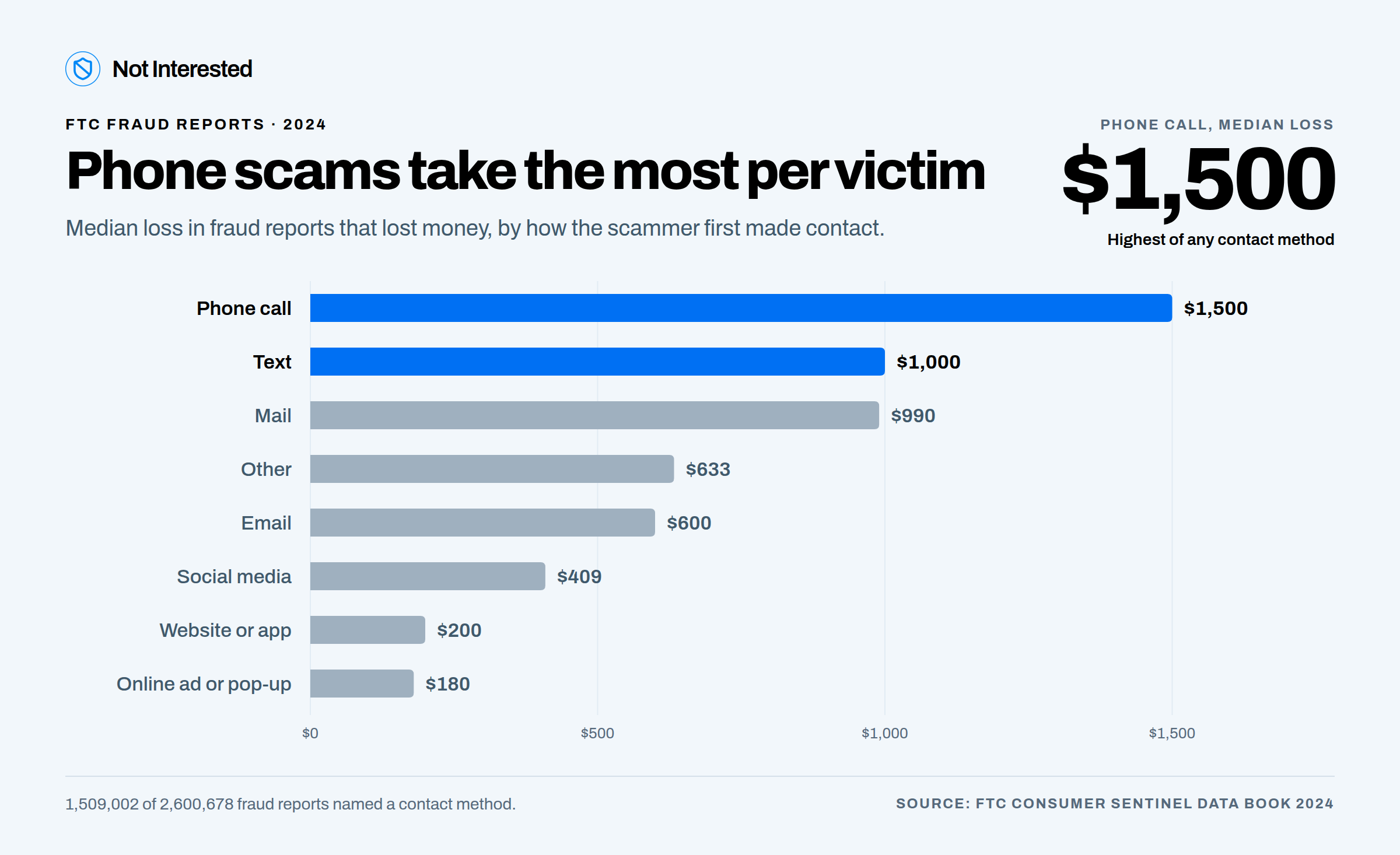
When a scam that started with a phone call worked, the typical victim lost $1,500. No other way of reaching you costs more. Texts came second at $1,000.
| Contact method | Reports | Total lost | Median loss |
|---|---|---|---|
| Phone call | 284,659 | $948M | $1,500 |
| Text | 246,784 | $470M | $1,000 |
| 42,108 | $90M | $990 | |
| Other | 148,288 | $1,072M | $633 |
| 371,651 | $502M | $600 | |
| Social media | 186,826 | $1,858M | $409 |
| Website or app | 186,663 | $976M | $200 |
| Online ad or pop-up | 42,023 | $246M | $180 |
Most reported text scams cost nothing, but a successful one costs $1,000
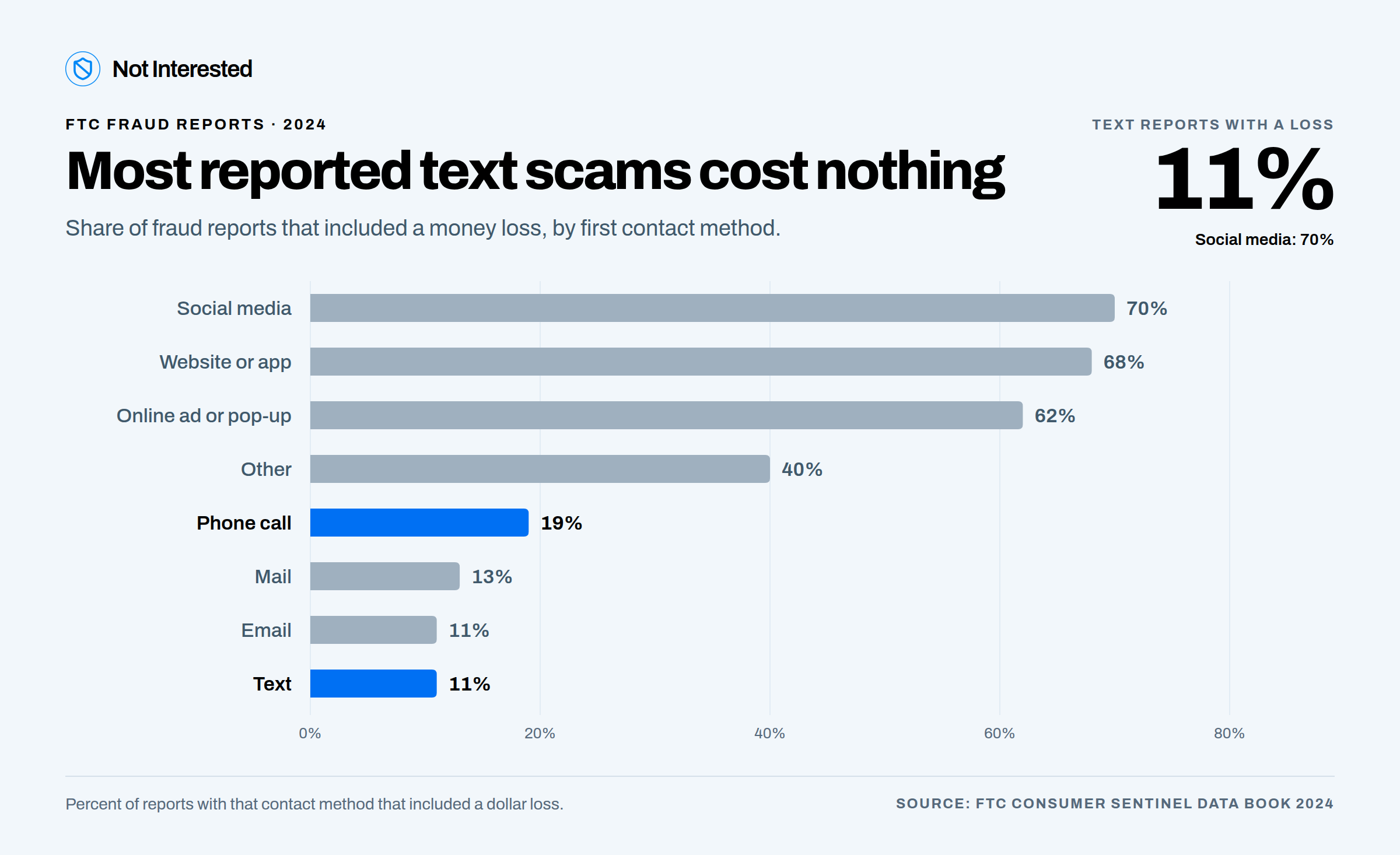
Only 11% of text reports and 19% of phone call reports included a money loss, compared with 70% for scams that started on social media. Most people who report a scam text never paid. But the ones who did lost a median of $1,000, so the cheapest move is never reading the text at all.
Phishing losses tripled in 2025
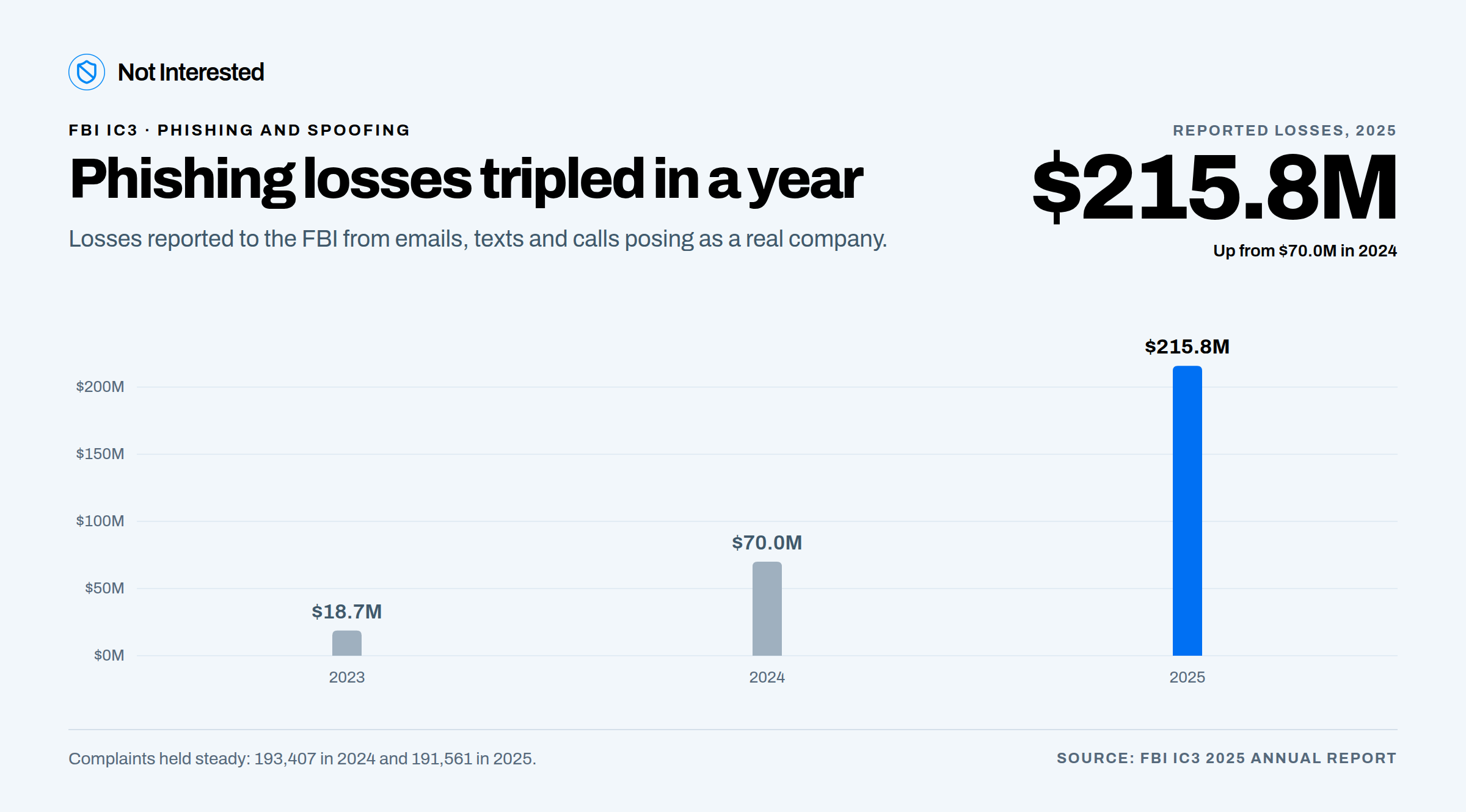
The FBI defines phishing and spoofing as "the use of unsolicited email, text messages, and telephone calls purportedly from a legitimate company requesting personal, financial, and/or login credentials." Complaints held steady. The money lost more than tripled.
| Year | Complaints | Losses |
|---|---|---|
| 2023 | 298,878 | $18,728,550 |
| 2024 | 193,407 | $70,013,036 |
| 2025 | 191,561 | $215,843,126 |
Seniors lose money less often, but lose more when they do
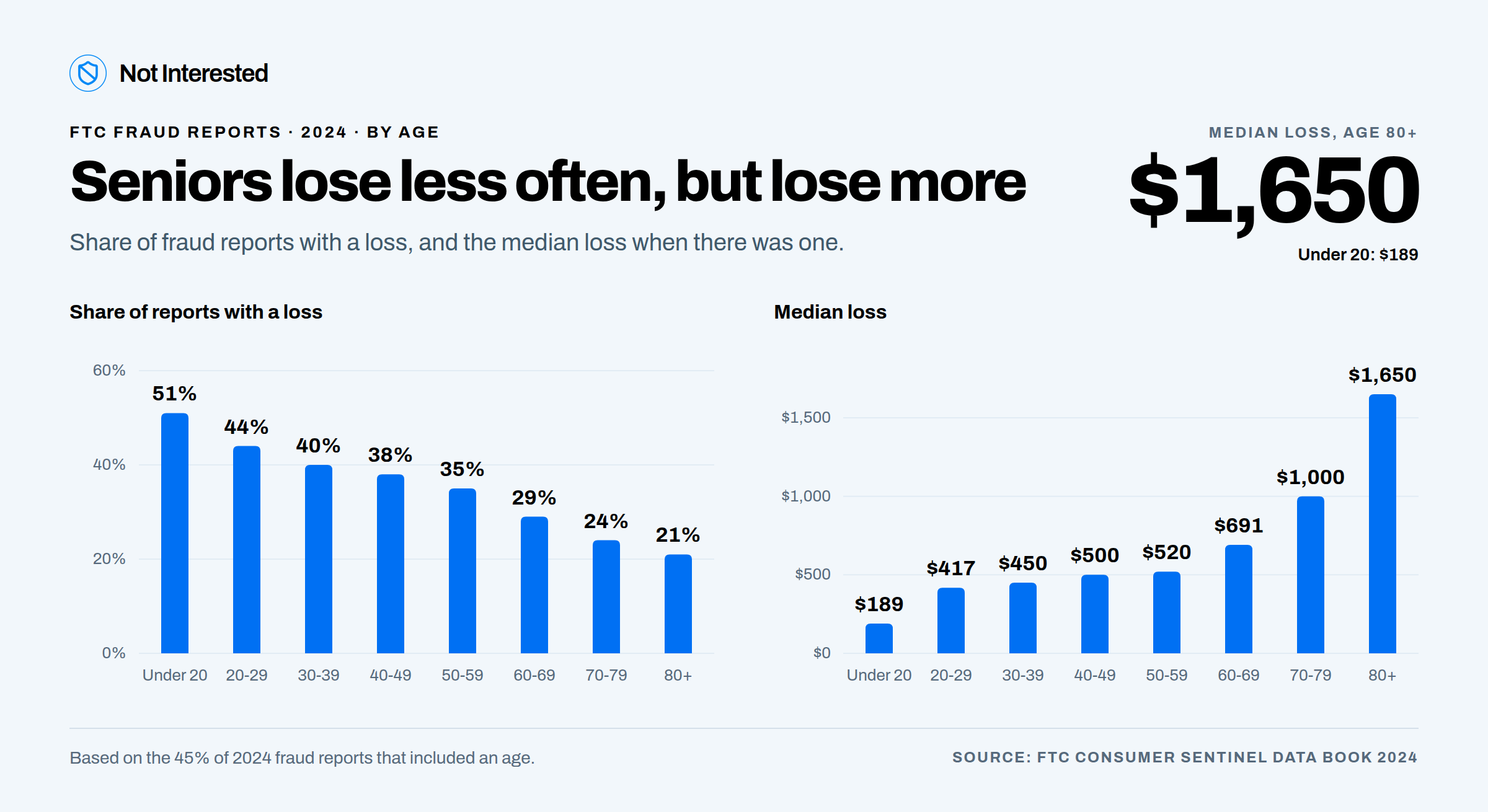
Younger people report losing money more often: 51% of fraud reports from people under 20 included a loss, against 21% for people 80 and over. But when older people lose money, they lose far more: a median of $1,650 at 80 and over.
| Age | Reports with a loss | Median loss |
|---|---|---|
| Under 20 | 51% | $189 |
| 20-29 | 44% | $417 |
| 30-39 | 40% | $450 |
| 40-49 | 38% | $500 |
| 50-59 | 35% | $520 |
| 60-69 | 29% | $691 |
| 70-79 | 24% | $1,000 |
| 80 and over | 21% | $1,650 |
The FBI's numbers point the same way: people 60 and over filed 201,266 complaints in 2025 and reported $7.7 billion in losses, more than any other age group.
Unwanted call complaints are down about 48% since 2021
The FTC's Do Not Call data for fiscal year 2025 shows complaints about unwanted calls about 48% lower than in fiscal 2021, when the FTC received about 5 million. Robocalls still make up most complaints. 4.7 million numbers were added to the Registry that year, for 258.5 million in total.
The states with the most Do Not Call complaints per 100,000 people:
| State | Complaints per 100,000 people |
|---|---|
| Arizona | 1,028 |
| Tennessee | 1,017 |
| Nevada | 960 |
| Illinois | 943 |
| Florida | 933 |
The Registry only stops sales calls from real companies. See why you're getting so many spam calls.
Both sources count only reported scams
Both sources count only what people chose to report. The FTC says its data "is based on unverified reports filed by consumers" and "is not based on a consumer survey." The FTC's dollar figures count reports with a loss between $1 and $999,999.
Sources
- FTC, Consumer Sentinel Network Data Book 2024 (March 2025), pages 8, 10, 12 and 13.
- FBI Internet Crime Complaint Center, 2025 IC3 Annual Report, complaint and loss comparisons and age data.
- FTC, National Do Not Call Registry Data Book, fiscal year 2025 (December 11, 2025).
You're welcome to use the charts on this page. Please credit Not Interested and link back to this page.
The cheapest scam is the one that never reaches you
Learn how to stop spam texts on iPhone and how to block spam calls on iPhone, or get Not Interested to screen texts from unknown senders and block known spam calls.